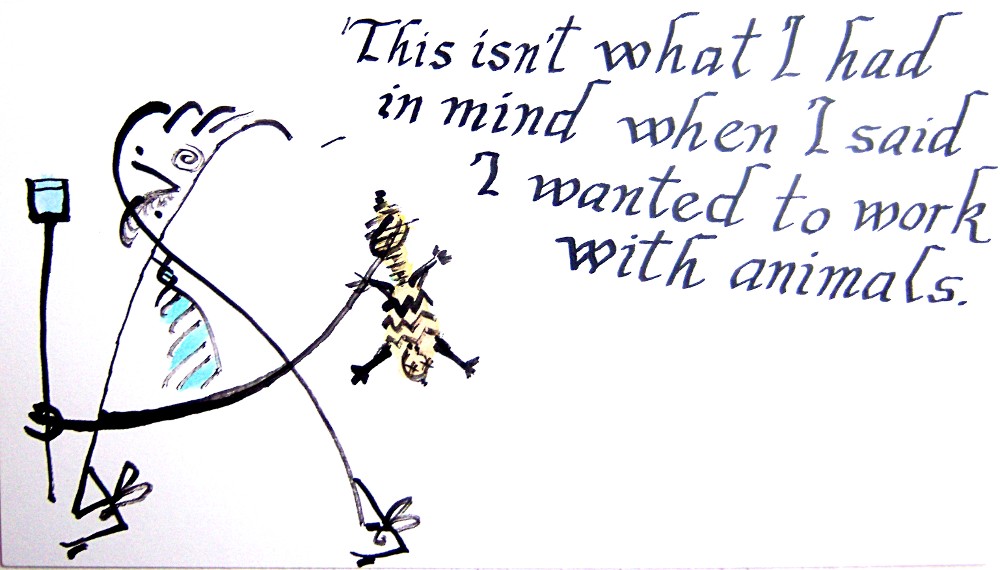
As promised...
8.06.2011
8.05.2011
Trudy in a paper bag
I don't normally work with chalk - that is, draw with chalk... at least outside of class. Anyway, I should have put this up last night, because this morning it appears that one of the kitties (I'm guessing Trudy) walked all over it last night, and little kitty pawprints do not improve the overall effect.
8.02.2011
Just pictures today
7.27.2011
Link, and reed pens

I like this story... and I think it goes along with what I've posted recently. Not that everyone who reads Ayn Rand is a murderous psychopath, but it certainly reinforces any tendencies that you might have in that direction in a way that reading, let's say, Paul Krugman, doesn't.
7.13.2011
Two things about Ayn Rand
I would probably get tired of bashing Ayn Rand if I didn't think that an increasing number of people take her writings seriously; but neither of these things are new.7.05.2011
Prints, and a painting
The Plum Blossom painting is on a wooden panel, 24 inches square (you may recognize the dimension and material from here, here and here, among other paintings: my favorite!).
You may also recognize the coffee cup - another favorite, working its way through various incarnations (eventually, a linocut!) - but I did this a year or so ago, one of my first successful DIY screenprints.
"Orbits" was an experiment that didn't work out quite as I had intended, but came out adequately well. This is actually printed on nice paper (Johannot), whereas the other things are printed either on cardstock or copy paper.
The first bicycle print is on copy paper, but as I type this prints on the Johannot paper, in turquoise, are drying; I'll post those later in the week. The black was just to get a sense of the block, to see if it was finished (almost, but not quite). But I think it came out fairly well.
Finally, the bicycle print with rider (and you should recognize the rider from my previous post). The rider should stand out a bit better on the turquoise ink than he does on the black, but the idea comes across.
As usual, I think the weak link is the photography, but that's getting better, too. What I really need is a tripod of some sort.
7.02.2011
What shall I do?


I'm once again looking for a job, but it's not entirely clear what I ought to even apply for.
When I was in high school, we were given a large standardized test relating to future employment, determining both strengths and interests. I scored as having strengths in everything they tested (which I believe demonstrates the limitations of such tests - I'm a good test taker, but probably wouldn't have done well in many of the occupations!) - but when it came to interests, the test results indicated that I was only interested in things they couldn't test (I believe it was art and writing, but it may have been music and writing).
In college, I took a psychology class on personality, and read (related to, but not for, the class) Carl Jung's book Psychological Types. This led me to the Myers-Briggs personality types (I have probably mentioned this before, but I am an INFP).
There is a book which relates the Myers-Briggs to careers: Do What You Are, and I have the second edition. So, what does it say?
For the INFP, the first category is "Creative/Arts"; the second is "Education/Counseling"; the third is "Religion." (For each of the sixteen types, there is a different list of categories; e.g., the ESTJ's top three categories are "Sales and Service," "Technical/Physical" and "Managerial") If you know me (and other INFPs), these categories make sense. I don't find them helpful at the moment, though. Moving to careers under the categories isn't helpful either: for Creative/Arts, the first two careers are "Artist" and "Writer," for Education/Counselor, "College professor: humanities/arts," and for Religion, "Minister/priest."
As an unprogrammed Quaker, I'm not particularly interested in becoming a minister (despite having an MDiv); I would certainly like to be a professor in the humanities, but so would lots of other people with similar credentials. And then we're back to the results of my high school aptitude test.
I've also been making prints.
7.01.2011
Friday afternoon

I said I would return to previous themes, and I've been painting (house) this week, which has given me time to ruminate. (There's a relevant Nietzsche quote that belongs there, but I'm too lazy to look it up at the moment, and far enough out from my book to be able to pull it up from memory.)
Last time I wrote, "I neither expect nor really want my students to ponder epistemological questions, but there's something important about flexing those muscles." There are two pieces there that probably need clarification.
First, I do want my students to ponder epistemological questions. However, I usually tell them that the great skeptic Hume liked to drink beer and shoot pool (more or less true) and didn't spend his life paralyzed by questions of causation. Being aware that there are various ways of approaching questions, different ways of gathering and analyzing evidence, is very important; and to a certain extent, understanding the difference between foundationalism (Stanford and IEP) and coherentism (IEP and Stanford) is also useful - but practical matters take precedence, and getting bogged down isn't useful, and even serious philosophers don't wrestle with Descartes' dream argument in their everyday lives.
I say this partly because I received an essay (9 pages long, when the assignment was 3-5 pages - a bad start) that included the following:
Let A=K*E1 with K being the fundamental constant that converts the experience, E, to knowledge.[If this is your essay and you want me to identify you as the author, let me know. But I'm pointing out your idiocy here, and still wondering if you were stoned when you wrote it.]
The second part is about flexing mental muscles. I may have mentioned that my students at an unnamed Syracuse-area college (which was not Syracuse University) seemed unfamiliar with the idea of thinking. That is, I would point to a sentence in the text, and asked what the author might have meant, and they would repeat the sentence back almost verbatim. I would read their essay drafts, and say, "this needs further clarification," and they would be unable to add anything at all. (This was multiple students, over the course of the semester.) I don't particularly care if they understand the ins and outs of Kant's epistemology or Nietzsche's critique of it - it would be nice, and probably helpful for them, but they're not philosophers - but I wonder how they process the news, or if they can even tell the difference between content and advertisement, information and opinion, or informed opinion and dogma. Epistemology matters; but as I said last time, it's not precisely Kant that I want you to learn.
6.28.2011
Two for Tuesday


Two (rambling) thoughts, which I may expand on later.
Second, prodded both by my friend Terry (who doesn't seem to have posted lately) and by Fareed Zakaria, a bit of Ayn Rand bashing. Ayn Rand was a refugee from Communist Russia, and one of her goals was to develop a political philosophy that was the opposite of Communism as she understood it. Fair enough; but in doing so she came up with a dogmatic (as opposed to properly philosophical* position unconnected to reality - which would be fine if members of Congress weren't quoting her in public. (I should have a link for that, but it eludes me at the moment).
*Something I rarely include in my "go read Nozick instead" is that he eventually renounced libertarianism. That's what I mean by "truly philosophical" = willing to follow your premised to their conclusion, and being willing to revise those conclusions.
6.25.2011
Saturday Afternoon
6.24.2011
More cartoons
6.20.2011
Cartoons!


So, today is the day that I post some cartoons.
6.17.2011
Informal fallacies
In a recent post on a blog I don’t usually read, a libertarian accused people who invoke Somalia against libertarians of making a false dichotomy. Well, no.
The Mercatus Institute’s freedom score was significantly linked to (by state)- lower educational attainment (measured by percent of Bachelor degrees or higher), lower population density, lower per capita GDP, increased infant mortality, increased accident mortality, increased incidence of suicide, increased firearm mortality, decreased industrial R&D, and increased income inequality.I'm sure there are a host of factors, and these statistics can't be reduced to a larger vision of society and the role of government. And yet.... it’s a slippery slope, do you really want to go down it?
6.10.2011
So, these aren't exactly cartoons, either...
but I have some, somewhere. I promise. And I'll post them at some point.
To stop those monsters, one-two-three, Here's a fresh new way that's trouble-free.
It's got Paul Anka's guarantee; guarantee void in Tennessee
Just don't look, just don't look..."
6.08.2011
Sketchy
So, I promise a more substantive analysis of... something or other... at some point in the relatively near future. And I also promise more cartoons. But today I wanted to follow up on a recent post regarding figure drawing, and show you what I've been up to (when I'm not drawing cartoons and reading various non-required matter): actual people (and a couple animals) rather than a still life!
6.06.2011
Squares!
I promised squares a while back, fiddled with these and then forgot about them.
5.23.2011
Final Exam
Q: Why are empiricists more likely to be Utilitarian in ethics? How does this carry over to their approach to justice?
5.17.2011
NT, right?
5.14.2011
The Social Contract
I have a stock response with regard to Ayn Rand: if you haven't read her by the time you're 19, don't bother. (Admittedly, the specific age sometimes changes by a year, plus or minus, depending on my mood - never past twenty, though.) Sometimes I add a second part: if you want to read serious libertarian political philosophy, read Robert Nozick's Anarchy, State, and Utopia.
5.12.2011
Two Thoughts...
...before I teach my final class at RIT. And for that matter, perhaps ever: I am tired of teaching part-time, and although I've been offered contracts for the fall at all three of the institutions at which I've been teaching, none of them can offer any assistance over the summer, and none of them can offer me anything other than part-time work. I don't mean to sound bitter (which is always a bad thing to preface a blog post with), but I'm tired of this, and two particular reasons come to mind. (If you're not interested, please just read the cartoons and ignore the text: you're not my students!)
4.26.2011
Misrepresentation, but without taxation

I've seen an odd thing several times recently: people asserting or assuming that socialists want to give unlimited power to the state. (I can come back and find links if anyone cares about the particulars.) That's just a non-sequitur: as a quick perusal of Wikipedia will show (and I will not provide a link), it has nothing to do with the power of the state, only with the relative distribution of wealth and power relations.
There is of course an argument for supporting this: make things worse, make them so bad that the people will finally rise up! I'm not that kind of socialist, though.
4.04.2011
Just Cartoons today
2.28.2011
Squares!
2.09.2011
So that explains it…

I just read an article which, taken together with a couple other recent articles, helps me understand what I’ve been seeing in students lately.
The most recent story indicates that New York students are not meeting standards for college preparedness: “just 5 percent in Rochester” meet these standards, to take a non-random example. I look at my students (two different schools, neither of which I need to name here), and say to myself, yes. Most of my students don’t come from Rochester, and of course I have good students in all of my classes. But there does seem to be a lack of preparation for college: do they know what they’re getting into?
The next story is something I read a few weeks back, but was on NPR this morning, regarding student performance. There are two factors here. The first is that teachers seem to be demanding less of their students; this makes sense, given that student evaluation is largely correlated with perceived grade, and there is a large segment of the population (such as myself) who more or less depend on those numbers for continued employment (I’ve never been explicitly turned down for a job based on them, but I worry about it). I suspect the second factor is correlated to the first, because students will complain regardless of what you ask: the second factor being that studying is down by half from a couple of decades ago. (That means the average amount my students are studying really is less than what I was doing at their age: I’m not just being cranky, I have statistics.) And another “correlation-does-not-imply-causation-but…” piece: they aren’t learning as much. Is this because they’re not being challenged, or because they’re not studying, or both? And they’re not measuring general knowledge: they’re looking at critical thinking skills (you know, the reason you not only don’t listen to Glenn Beck, but don’t understand why anyone does). Although a friend of a friend chided me a few months back for lacking “critical thinking” with regard to certain economic policies, this is one of the main things I teach, regardless of the course title. I don’t care if you know what Empiricism is, but I don’t want you to get your information about it from Swami Krishnananda, or a website built by high school students over a decade ago. Which is to say, be able to find out who is putting out the information, then evaluate whether it’s reliable or not. You know, critical thinking. It's a good thing.
What do we have so far? Students are unprepared for college, studying fewer hours and learning less. Where could we possibly go from here? The Chronicle of Higher Education, of course. Students today “give themselves high marks for ambition,” higher than in the past, but also – and they do say these things are linked – report record low emotional health. Well, duh. Perhaps it's the cognitive dissonance catching up, compounded by the realization that they don't really know what to do about it. (That's my job of course, but a surprising number of the students don't seem to recognize it.)
Now you have a snapshot of my classes: they are ambitious, they want to achieve. But they enter college unprepared to actually do the work, don’t do the relatively short reading assignments that I give them, and then are anxious and depressed.
And yet, somehow I still enjoy teaching.


