10.06.2011

October already?

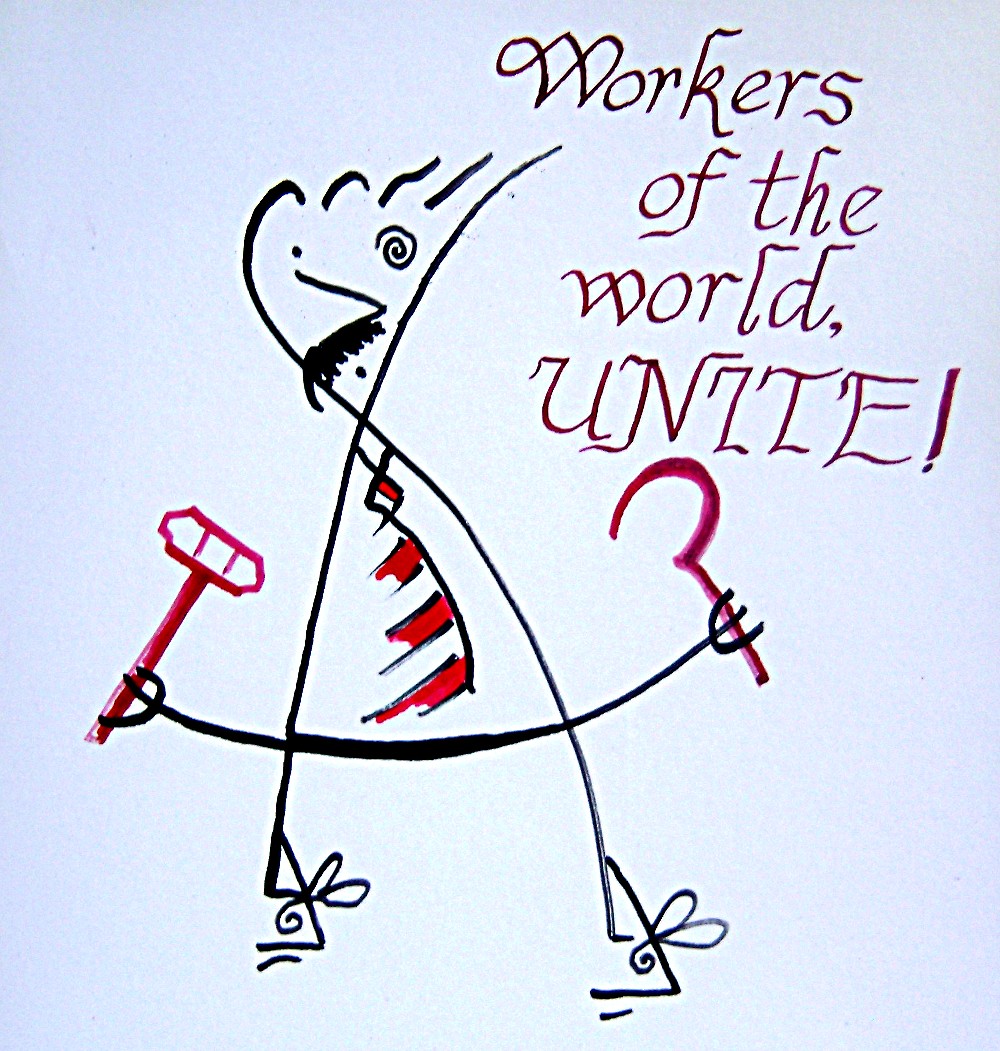
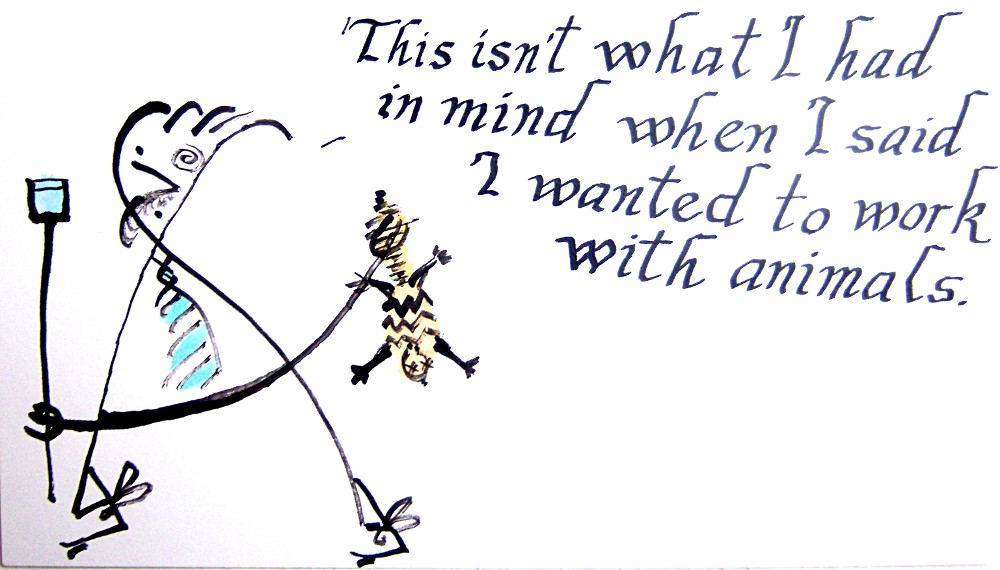
I hadn't realized quite how long it had been since I posted... and also, haven't drawn anything in about that long. So here's an old cartoon I drew last winter, as we approach winter once again.

(It's funny how, when I'm walking or driving somewhere, I can think of fairly complex topics on which I want to post, but once I'm in front of a computer... oh well.)

8.19.2011

Radio, Radio


Okay, so I've used this title before, and neither this post nor the last has anything to do with Elvis Costello (whom I've been listening to on YouTube lately).
I may have mentioned that the CD player in my car died about a year ago, just as I was starting my hour-plus commute twice a week; thus, I've been listening to the radio a lot here in CNY. What have I found? A lot of stations that are surprisingly like the one I listened to as a teenager (KGON - note that they're advertising Def Leppard) and the station I listened to in Roanoke when I was painting houses (WROV). Classic rock, and today's best rock! Well, not so much.
But it's not just one station here: I've been driving all over CNY, so I listen to stations from Kingston, Ontario and Watertown (NY), through Syracuse, the Finger Lakes, and into Rochester
(and I'm not going to list the stations, there's seven I listen to regularly and I really don't remember all their call letters). Collectively, they play more Neil Young, Rush, Guess Who, BTO, Red Rider, Neil Young (yes, they play a lot of Neil Young) - that is, Canadian bands - than I'm used to, but that's okay. However, it's somewhat dismaying to hear so much Lynyrd Skynyrd and Allman Brothers: I thought I left the south!

The cartoon is related to this post - credit to Julie for the link.

8.16.2011

Plum blossoms, again


This time with a better picture - varnished and in the frame correctly.

8.15.2011

Boris Badenov for President!

Sad having missed vote-buying in Ames, IA, Boris now wants to enter the race for president.

He will slash your taxes - and your tires!
He will slash government spending - and the government's tires!

8.10.2011

Painting for Wednesday


Sometimes I like the ambiguity of the title, "painter"... and other times, not so much. In any case, this is all the painting I've done this week.
From Ogata Korin (1658-1716)'s Red and White Plum Blossoms. It's not varnished, and therefore not in the frame correctly, but this gives a good sense of the mostly-finished product.
Soon to be hanging in a conference room near you (if you happen to live in Syracuse, NY)!

8.09.2011

"Liberty"?


This actually isn't the post I promised a while back, but related: what do we mean when we talk about "liberty"?
Michele Bachmann: "Whether it’s economic liberty, religious liberty, liberty in our finances, liberty in being able to choose the profession we have." (Link) Religion, yes; but please note that the other three things are all about money. (And what is love of money the root of?)

In the Bill of Rights, the best you can do to support this view is the Ninth Amendment; since I am relatively sure that most of my readers have no idea what it says, here's the complete text: "The enumeration in the Constitution, of certain rights, shall not be construed to deny or disparage others retained by the people."

So what else is contained in the Bill of Rights? Free speech, freedom of the press; freedom to assemble peaceably, the right to petition the government for a redress of grievances, in the first amendment alone. Note that these are positive freedoms, things we can do, rather than negative freedoms. Negative freedoms include not having to quarter soldiers, not being subjected to unreasonable search and seizure, not being compelled to serve as witness against oneself, deprived of due process, or have private property take for public use without just compensation. Positively, we should be allowed a speedy and public trial, by jury if we so choose. Negatively, we shouldn't be subject to cruel or unusual punishment. I have left off the second and tenth amendment - I'll come back to those shortly. It's important to notice that all of these have to do with overreach by government, the sorts of overreach that the colonists were subject to and wanted to prevent in this new country. It doesn't say anything about economics, a field that was just barely getting started at the time this was written; that cuts both ways, in that the founders weren't thinking about it one way or another, at least in concrete ways they were willing to enshrine in the bill of rights. I can also certainly point to instances where these seem to have been violated; the city in which I live still bears the scars of private property taken for public use - the interstate freeway - that wasn't compensated justly, to name one example off the top of my head.

I'm surprised that Michele Bachmann didn't mention the second amendment, but of course it wouldn't have fit with the narrative of either economic freedom or why her ancestors came to this country. Also, the tenth amendment has been getting more press recently, in terms of states' rights. Just one quick note, since I don't think this can be said often enough these days: the secession of the Confederacy wasn't about "rights" in the plural, only about one "right": the "right" of a person to own another as property.

What do we not see in the bill of rights? "Economic liberty... liberty in our finances, liberty in being able to choose the profession we have." Not that I want the government telling me what job I can do (although the government telling me what job I can't do - for instance, I don't think you would want me to do tattoo removal - is a good thing!) But there is there is a lot more to "liberty" than being able to buy cheap stuff at WalMart and pollute the earth with your SUV.

8.05.2011

Trudy in a paper bag


I don't normally work with chalk - that is, draw with chalk... at least outside of class. Anyway, I should have put this up last night, because this morning it appears that one of the kitties (I'm guessing Trudy) walked all over it last night, and little kitty pawprints do not improve the overall effect.

Tomorrow: cartooons!

8.02.2011

Just pictures today


No real commentary today, except to note that for those of us who are looking for jobs, everything happening in Washington lately is very depressing. What was that Kent Conrad was saying about improving confidence?
Bah.

7.27.2011

Link, and reed pens


I like this story... and I think it goes along with what I've posted recently. Not that everyone who reads Ayn Rand is a murderous psychopath, but it certainly reinforces any tendencies that you might have in that direction in a way that reading, let's say, Paul Krugman, doesn't.

In other news, I've recently purchased a reed pen - how did I live without it! I will now be the eccentric fellow who takes his bottle of ink and sketchpad everywhere!

7.13.2011

Two things about Ayn Rand

I would probably get tired of bashing Ayn Rand if I didn't think that an increasing number of people take her writings seriously; but neither of these things are new.
First, I mentioned before that she set out to create a "political philosophy that was the opposite of Communism as she understood it... in doing so she came up with a dogmatic position unconnected to reality." But there's one piece that wasn't the opposite of the Communism that she fled: she was an atheist. That's not remarkable in itself, but insofar as the Tea Party harbors elements of the Religious Right - and insofar as Rand Paul identifies as a Presbyterian - there's a fundamental problem. That is, she isn't incidentally an atheist: it's an essential part of her position, in the same way that it's an essential part of Richard Dawkins' or Daniel Dennett's approach to the world.
Second, she was a bit of sociopath. Or rather, she admired a brutal killer for his casual disregard for other people, his flouting of societal conventions (like, "Thou shalt not kill."). Hickman was clearly a sociopath, and Ayn Rand saw this as a heroic quality that set him apart from the herd (and speaking of herds, let me just mention that there's a deep tension in Nietzsche's writings in his rejection of herd morality, the positive things he sees that herd morality has contributed to modern humanity, and the ineluctable interconnection of all things - and Ayn Rand criticized him for it).
Two further thoughts on this second point: first, as with her atheism, this isn't very different from her understanding of the Communist regime she fled. Second, it seems to me that her atheism and her admiration of this sociopath aren't disconnected; in contrast, both Dawkins and Dennett promote a humanistic vision that rejects such brutality.
As I said, neither of these points are revelations, I would just like to see some recognition that her views are antithetical to Christian principles.
The Tea Party can go one way or the other, but there's no splitting the difference on this.

7.05.2011

Prints, and a painting

I was going to - and may yet - write a bit about what "liberty" might mean, and what security we might have... and why this guy is an idiot. But today I've just been job searching, reading the news, and working on prints and pictures. So, a bit about what's posted here.

The Plum Blossom painting is on a wooden panel, 24 inches square (you may recognize the dimension and material from here, here and here, among other paintings: my favorite!).


You may also recognize the coffee cup - another favorite, working its way through various incarnations (eventually, a linocut!) - but I did this a year or so ago, one of my first successful DIY screenprints.


"Orbits" was an experiment that didn't work out quite as I had intended, but came out adequately well. This is actually printed on nice paper (Johannot), whereas the other things are printed either on cardstock or copy paper.


The first bicycle print is on copy paper, but as I type this prints on the Johannot paper, in turquoise, are drying; I'll post those later in the week. The black was just to get a sense of the block, to see if it was finished (almost, but not quite). But I think it came out fairly well.
Finally, the bicycle print with rider (and you should recognize the rider from my previous post). The rider should stand out a bit better on the turquoise ink than he does on the black, but the idea comes across.

As usual, I think the weak link is the photography, but that's getting better, too. What I really need is a tripod of some sort.

7.02.2011

What shall I do?


I'm once again looking for a job, but it's not entirely clear what I ought to even apply for.
When I was in high school, we were given a large standardized test relating to future employment, determining both strengths and interests. I scored as having strengths in everything they tested (which I believe demonstrates the limitations of such tests - I'm a good test taker, but probably wouldn't have done well in many of the occupations!) - but when it came to interests, the test results indicated that I was only interested in things they couldn't test (I believe it was art and writing, but it may have been music and writing).
In college, I took a psychology class on personality, and read (related to, but not for, the class) Carl Jung's book Psychological Types. This led me to the Myers-Briggs personality types (I have probably mentioned this before, but I am an INFP).
There is a book which relates the Myers-Briggs to careers: Do What You Are, and I have the second edition. So, what does it say?
For the INFP, the first category is "Creative/Arts"; the second is "Education/Counseling"; the third is "Religion." (For each of the sixteen types, there is a different list of categories; e.g., the ESTJ's top three categories are "Sales and Service," "Technical/Physical" and "Managerial") If you know me (and other INFPs), these categories make sense. I don't find them helpful at the moment, though. Moving to careers under the categories isn't helpful either: for Creative/Arts, the first two careers are "Artist" and "Writer," for Education/Counselor, "College professor: humanities/arts," and for Religion, "Minister/priest."
As an unprogrammed Quaker, I'm not particularly interested in becoming a minister (despite having an MDiv); I would certainly like to be a professor in the humanities, but so would lots of other people with similar credentials. And then we're back to the results of my high school aptitude test.
I've also been making prints.

7.01.2011

Friday afternoon


I said I would return to previous themes, and I've been painting (house) this week, which has given me time to ruminate. (There's a relevant Nietzsche quote that belongs there, but I'm too lazy to look it up at the moment, and far enough out from my book to be able to pull it up from memory.)
Last time I wrote, "I neither expect nor really want my students to ponder epistemological questions, but there's something important about flexing those muscles." There are two pieces there that probably need clarification.
First, I do want my students to ponder epistemological questions. However, I usually tell them that the great skeptic Hume liked to drink beer and shoot pool (more or less true) and didn't spend his life paralyzed by questions of causation. Being aware that there are various ways of approaching questions, different ways of gathering and analyzing evidence, is very important; and to a certain extent, understanding the difference between foundationalism (Stanford and IEP) and coherentism (IEP and Stanford) is also useful - but practical matters take precedence, and getting bogged down isn't useful, and even serious philosophers don't wrestle with Descartes' dream argument in their everyday lives.
I say this partly because I received an essay (9 pages long, when the assignment was 3-5 pages - a bad start) that included the following:

Let A=K*E1 with K being the fundamental constant that converts the experience, E, to knowledge.
[If this is your essay and you want me to identify you as the author, let me know. But I'm pointing out your idiocy here, and still wondering if you were stoned when you wrote it.]

For those of you who are unfamiliar with epistemology - a group which includes the author of this quote - the "fundamental constant, K" is basically what philosophers have been arguing about for millennia. To think that it can be captured in a constant and dropped into an essay is merely to demonstrate that you haven't been to class or read the text. So, I really do want my students to think about problems in epistemology, but do so seriously when they do, and not to become paralyzed or go to graduate school to study epistemology further.

The second part is about flexing mental muscles. I may have mentioned that my students at an unnamed Syracuse-area college (which was not Syracuse University) seemed unfamiliar with the idea of thinking. That is, I would point to a sentence in the text, and asked what the author might have meant, and they would repeat the sentence back almost verbatim. I would read their essay drafts, and say, "this needs further clarification," and they would be unable to add anything at all. (This was multiple students, over the course of the semester.) I don't particularly care if they understand the ins and outs of Kant's epistemology or Nietzsche's critique of it - it would be nice, and probably helpful for them, but they're not philosophers - but I wonder how they process the news, or if they can even tell the difference between content and advertisement, information and opinion, or informed opinion and dogma. Epistemology matters; but as I said last time, it's not precisely Kant that I want you to learn.

6.28.2011

Two for Tuesday


Two (rambling) thoughts, which I may expand on later.
First, thinking about the purpose of teaching philosophy to undergraduates. I was readings a dialogue by another philosophy adjunct, and I was reminded of the Karate Kid. Not a great movie, and I haven't seen it since it first came out, but one scene has stayed with me: Mr. Miyagi telling the boy to wax his car. The boy is dismayed, but there is a purpose unrelated to the waxing of cars. Similarly, I neither expect nor really want my students to ponder epistemological questions, but there's something important about flexing those muscles. What does it mean to understand someone else's position? Can we be simultaneously critical and charitable when hearing ideas different from our own? (I will probably elaborate on this at length in a future post.)

Second, prodded both by my friend Terry (who doesn't seem to have posted lately) and by Fareed Zakaria, a bit of Ayn Rand bashing. Ayn Rand was a refugee from Communist Russia, and one of her goals was to develop a political philosophy that was the opposite of Communism as she understood it. Fair enough; but in doing so she came up with a dogmatic (as opposed to properly philosophical* position unconnected to reality - which would be fine if members of Congress weren't quoting her in public. (I should have a link for that, but it eludes me at the moment).


*Something I rarely include in my "go read Nozick instead" is that he eventually renounced libertarianism. That's what I mean by "truly philosophical" = willing to follow your premised to their conclusion, and being willing to revise those conclusions.

6.25.2011

Saturday Afternoon


Yet another post that mostly features pictures rather than text, although there is a bit of text in the story. And a cheery story it is!

6.24.2011

More cartoons


..because you probably don't just want to hear me bash Ayn Rand. (Although if you do, please leave a comment and I will oblige.)

6.20.2011

Cartoons!


So, today is the day that I post some cartoons.
I may have mentioned that I'm not drawing as many these days, mostly because I'm not barraged by the constant stream of nonsense as when I started this blog.
Also, I've been reading Paul Krugman, whom I find edifying but not particularly amusing.

6.17.2011

Informal fallacies


In a recent post on a blog I don’t usually read, a libertarian accused people who invoke Somalia against libertarians of making a false dichotomy. Well, no.

If I were to say, "if you don’t support President Obama, you hate poor people" – that’s a false dichotomy; perhaps you voted for Kucinich and don't think the President has gone nearly far enough. If someone were to say, "if you don’t support this bill that gives the government far-reaching power to encroach on our freedoms, then you hate freedom" – that’s also a false dichotomy. The Patriot Act has never seemed particularly patriotic to me.

On the other hand, if I say, "if you want to see where libertarian philosophy will get you, just look at Somalia," I’m doing something else entirely. It’s called a Slippery Slope. And the funny thing about slippery slopes is that they’re not always fallacies.

If you look at Ronald Reagan’s attack on Medicare, you can see a slippery slope as a fallacy. But big changes rarely happen overnight: there’s usually an incremental process involved. To identify a small change which opens the way for future (implied, bad) change is to point to a slippery slope, but sometimes it’s true. Martin Luther wasn’t really interested in having everyone reading the Bible for themselves, and I think his concerns about what that would lead to have been borne out: a massively fragmented Christendom.

I will continue to refer to Somalia, with two caveats. First, I don’t tend to listen too much to, say, Ron Paul or other contemporary American politicians who identify as libertarian; but I have read some of what they read, including but not limited to Ayn Rand, Robert Nozick, and Tara Smith. As an political theory, it’s not so much about the size or proper role of government so much as it is about dismantling the social contract. (If you disagree with this, you should say that I'm committing a Straw Man fallacy, and I will counter that you need to go back and reread Anarchy State and Utopia)

The second caveat is that the Somalis aren't really living out the consequences of libertarian political philosophy: things have fallen apart there for many reasons, and none of them can be blamed on Ayn Rand.

On the other hand, the quality of life in the US depends on a number of factors, some of which do have a direct link to libertarians. Freedom is important, but in what kind of society do you want to live?
The Mercatus Institute’s freedom score was significantly linked to (by state)- lower educational attainment (measured by percent of Bachelor degrees or higher), lower population density, lower per capita GDP, increased infant mortality, increased accident mortality, increased incidence of suicide, increased firearm mortality, decreased industrial R&D, and increased income inequality.
I'm sure there are a host of factors, and these statistics can't be reduced to a larger vision of society and the role of government. And yet.... it’s a slippery slope, do you really want to go down it?